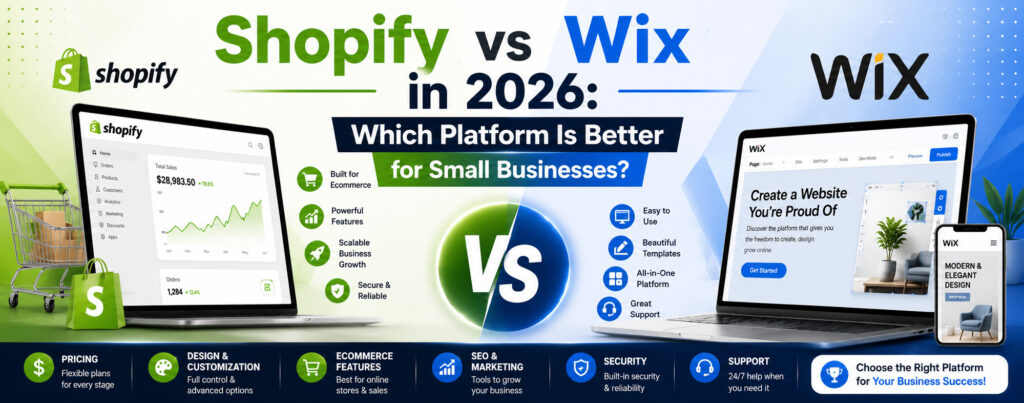
If you sell online, you already know the real question is not which platform looks nicer. The real question is Wix vs Shopify in 2026 which one puts more money in your pocket at the end of the year. Wix and Shopify both let you build a store without writing code, but they make money in different ways, charge fees in different ways, and fit different kinds of businesses.
The short answer: Wix usually wins on cost for stores earning under 250,000 dollars a year, mainly because it charges zero transaction fees. Shopify usually wins once your yearly product revenue passes about 300,000 dollars, because its tools for inventory, multiple sales channels, and growth start to pay for themselves. This Wix vs Shopify breakdown explains why, with real numbers you can check against your own store.
Wix vs Shopify in 2026: Quick Verdict
| Your situation | Better choice |
| You sell under 50 products, and design matters a lot | Wix |
| You run a mixed business with bookings, classes, or services, plus a small shop | Wix |
| You sell mostly in one country and one currency | Wix |
| Your yearly product revenue is under 250,000 dollars | Wix |
| Selling products is your whole business, not a side feature | Shopify |
| You sell across borders in different currencies | Shopify |
| You sell on Amazon, TikTok Shop, or other marketplaces too | Shopify |
| You accept cash on delivery or sell in South Asia, the Middle East, or Latin America | Shopify |
| Your yearly product revenue is above 300,000 dollars and growing | Shopify |
Keep reading for the full Wix vs Shopify breakdown, because the numbers change quite a bit depending on your order volume and where your customers live.
Pricing and Transaction Fees Compared
Both platforms advertise a starting price near 29 dollars a month, and on the surface, that looks close to equal. It is not, and getting the comparison right matters, because plan pricing is the one place this kind of guide most often gets sloppy, so here’s the honest version, with monthly and annual pricing kept separate the whole way through.
On annual billing (the standard way most store owners actually pay), Wix Business runs about 36 dollars a month, and Shopify Basic runs about 29 dollars a month. On a pure plan-fee basis, Shopify is actually the cheaper of the two annually — the real gap opens up somewhere else entirely: transaction fees.
Wix does not charge any transaction fee on top of your normal payment processing, no matter which payment provider you use. Shopify does the opposite. If you use Shopify Payments (built on Stripe), you only pay the standard card processing rate. But if you use PayPal, a local bank, or any other payment provider instead of Shopify Payments, Shopify adds an extra charge on every sale — 2% on the Basic plan, dropping to 1% on Grow and 0.6% on Advanced.
Here is what that looks like in real numbers. Picture a small shop doing 8,000 dollars a month (96,000 dollars a year) in sales through an outside payment gateway, on annual billing for both platforms:
- Wix Business, annual plan fee: about 432 dollars a year. No transaction fee on top.
- Shopify Basic, annual plan fee: about 348 dollars a year, plus the 2% third-party gateway surcharge, roughly 1,920 dollars a year on that revenue. Add a few apps to match features Wix includes for free (reviews, loyalty, subscriptions), typically 360 to 900 dollars a year, and the full Shopify total lands between about 2,600 and 3,200 dollars a year.
That’s a real gap of roughly 2,200 to 2,800 dollars a year, driven almost entirely by the transaction fee, not the plan price. If Shopify Payments is available where you live and you plan to use it anyway, this gap shrinks dramatically, since the transaction fee disappears entirely. If it isn’t available in your country, or you already use a different payment provider for good reasons, this is the single biggest number in this whole comparison.
One more pricing detail worth knowing: Wix commonly runs first-year discounts that expire, so budget for your renewal price to run somewhat higher starting in year two. Check the exact renewal rate on your specific plan before committing, since Wix updates these periodically. If you’d rather not track these changes yourself, our team keeps a running eye on both platforms’ pricing as part of every Wix website design and Shopify development engagement.
Which Platform Makes More Money? Break-Even Revenue Analysis
This is the heart of the whole Wix vs Shopify decision, and it comes down to one simple idea. Shopify’s extra tools are worth their higher effective cost only once you have enough sales to use them, because once you use Shopify Payments directly, the transaction fee gap that favors Wix disappears, and Shopify’s plan fee alone is actually competitive or cheaper.
Based on real cost comparisons, the break-even point for a store still using an outside payment gateway sits somewhere between 250,000 and 350,000 dollars in yearly product revenue, assuming you also need features like multi-channel selling or advanced inventory tools. Below that number, the transaction-fee gap, plus app costs to replace Wix’s free built-in tools, make Wix the more sensible choice for most independent store owners running an outside gateway.
Above 500,000 dollars a year, especially for stores with large product catalogs, wholesale customers, or sales in many currencies, Shopify’s infrastructure earns its keep and usually pays for itself many times over, and if you’re on Shopify Payments from day one, that break-even point arrives much earlier, since the transaction-fee penalty never applies.
A useful rule many small business owners use: if you’re shipping fewer than 200 orders a month and using an outside payment gateway, Wix typically costs less overall than Shopify Basic once you add up plan fees, transaction fees, and the apps you’d need to match Wix’s built-in features. That rule flips if Shopify Payments is available and in use; at that point, it’s much closer to a wash on cost, and the decision comes down to features.
If your goal is simply to keep more of every dollar you earn while your business is still small and you can’t use Shopify Payments, that math favors Wix. If your goal is to build the biggest possible store over the next three to five years, Shopify’s foundation will save you a painful rebuild later — something our ecommerce team can help you plan for before you outgrow your current setup.
Design and Ease of Use
Design is where the Wix vs Shopify gap feels most personal, since it shapes how your brand looks every single day. Wix uses a drag-and-drop editor that lets you place any element exactly where you want it, down to the pixel. This freedom is a real advantage for photographers, artists, boutique clothing brands, and anyone whose brand depends on a distinctive look.
Shopify uses a section-based editor. You can add, remove, and rearrange blocks, but you cannot place things anywhere you want the way you can in Wix. This sounds like a downside, and for pure creative control, it is, but it comes with a benefit: it’s much harder to accidentally break your layout on a phone screen or slow down your page by stacking too many custom elements. If you want a fully custom build rather than a themed setup, that’s the kind of project our Shopify development team handles from scratch.
Wix offers more than 2,000 free templates, all included at no extra cost. Shopify offers around 230 themes, and the good ones usually cost between 180 and 400 dollars.
For someone with no design background, Wix tends to feel faster and more forgiving in the first few days. A working store, with products, checkout, and a connected domain, is often live within two to four days on Wix. Reaching that same polished result on Shopify usually takes five to ten days, mainly because getting a professional finish means customizing a theme and installing apps, not just filling in a template.
Shopify has a real learning curve. Most owners who set up their own store report spending 20 to 40 hours learning the system before launch, and many end up hiring a developer within six months once they want deeper customization. That time investment pays off in the long run through stronger automation and inventory tools, but it’s a real cost worth planning for.
One important detail about Wix: once you publish a template, switching to a different one later usually means rebuilding your site from the ground up. Shopify lets you swap themes without losing your products or settings. If you think your brand look might change significantly down the road, that’s worth remembering.
Ecommerce Features and Scalability
Wix caps you at 50,000 products, six options per product, and 1,000 variants per product. In practice, most stores start feeling the strain well before that ceiling, often somewhere around 1,000 products, when page loading and store management start to slow down.
Shopify supports unlimited products and handles large, complex catalogs without breaking a sweat. It also supports inventory tracking across multiple warehouses and wholesale pricing for business customers, features most small stores never need but growing ones eventually will.
The app stores tell a similar story. Shopify has somewhere between 12,000 and 16,000 apps, depending on which source you check, while Wix has closer to 800. For nearly any problem you run into on Shopify, loyalty points, subscription boxes, print on demand, you’ll usually find several competing apps to choose from. On Wix, you might find one option, or none at all, which sometimes means falling back on custom code.
That app advantage carries a real cost, though. Three commonly used Shopify apps together often add 360 to 1,800 dollars a year on top of your plan, since features Wix includes for free, product reviews, loyalty programs, and subscription billing, cost extra on Shopify.
If you sell through cash on delivery, or you sell into South Asia, the Middle East, or Latin America, this comparison isn’t close. Shopify’s app store includes tools for order verification through text message or WhatsApp, address checking, and courier connections to major regional carriers. It also connects natively to channels like TikTok Shop, which matters if social commerce is part of your growth plan. Wix has almost none of this built in, which means manual workarounds for problems Shopify solved years ago.
SEO Comparison
SEO is another spot where the Wix vs Shopify comparison has shifted a lot in recent years. The old claim that Wix hurts your Google ranking is out of date. Wix now generates clean web addresses, supports meta tags, includes structured data, and loads pages quickly using solid hosting infrastructure. For most stores with under 500 products, the SEO gap between the two platforms is small something our Wix SEO team confirms on every audit we run.
Shopify still holds a slight edge for very large stores, mainly because its blog structure and collection pages naturally create more indexable pages for Google to crawl on a big catalog. Shopify also automatically creates redirects when you change a product web address, which protects your search rankings, something Wix only does automatically on paid plans. If you’re weighing this tradeoff for a large catalog, our Shopify SEO specialists can walk through what it means for your specific site.
Both platforms support the basics well: editable page titles, meta descriptions, canonical tags, and automatic sitemaps. Wix actually leads in one area many guides miss: structured data for products is built directly into Wix, while Shopify usually needs a third-party app for the same result.
Bottom line, your actual writing and the quality of sites linking back to you will affect your ranking far more than which of these two platforms you choose.
AI Tools and Agentic Commerce in 2026
This is where the Wix vs Shopify race has changed the most in the last year, and it’s a part of the decision most comparison guides still ignore.
Wix built a new AI system called Wix Harmony, launched in January 2026, and inside it is an AI agent named Aria. Aria can build a full page or entire site from a plain-English description, redesign layouts, write copy, and set up commerce and booking tools, all while you keep full manual control to fine-tune anything by hand, down to the pixel, without Aria’s changes breaking other parts of the site. Aria is included on every Wix plan, including the free tier.
Shopify’s main AI assistant is called Sidekick, rebuilt substantially in Shopify’s Winter ’26 Edition and described by Shopify’s own leadership as more of a business co-pilot than a simple chatbot. Sidekick can now build custom apps, create automated workflows, and edit theme elements from plain-language requests, not just answer questions. A newer feature called Sidekick Pulse actively watches your store and proactively surfaces problems and opportunities before you go looking for them, such as a sudden drop in mobile conversions, for instance. Shopify Magic, a separate free tool, writes product descriptions, emails, and marketing copy in your brand voice at no extra charge on any paid plan.
The bigger shift for 2026 is what people call agentic commerce: customers researching and buying products directly inside AI chat tools like ChatGPT, Perplexity, and Microsoft Copilot, without ever visiting your actual website. Shopify built a feature called Agentic Storefronts specifically for this, letting your entire product catalog show up inside these AI conversations automatically, with checkout completable inside the chat itself. Shopify’s president has reported that orders arriving through AI-powered search grew roughly 15-fold since January 2025, a genuinely new sales channel, though it’s worth noting that figure grew from a small starting base, so treat it as a strong directional signal rather than a guarantee of scale for any individual store.
Wix is moving in a similar direction but hasn’t built out a dedicated selling channel inside AI chat tools at the same scale as Shopify yet. For a business planning to sell heavily through these new AI shopping channels, this points toward Shopify. For a business mainly focused on its own website and search engine traffic, either platform’s AI tools will genuinely save you time on daily tasks.
Wix vs Shopify for Hybrid, Service, and International Businesses
If your business is not just products. Say you run a yoga studio that also sells mats and gear, or you’re a photographer selling prints alongside bookings. Wix handles bookings, a blog, memberships, and a small shop all inside one dashboard, with no extra apps needed. Shopify can add booking tools through outside apps like Acuity or Booksy, usually 15 to 50 dollars a month, but those bookings and your product checkout run as two separate systems. For a business where half the revenue is appointments and half is product sales, that split is a real daily headache, not a small inconvenience.
If you sell across borders. Shopify supports multiple currencies and languages natively through a feature called Shopify Markets. Customers see prices in their own currency, pay in their own currency, and get refunds in their own currency. Wix shows prices in a single currency only, so international shoppers have to do the math themselves, which quietly costs you sales. If most of your customers live in one country, this won’t matter to you. If you’re trying to sell from London to customers in Toronto, Sydney, and Dubai, this difference becomes a dealbreaker.
If you’re a small shop on a local high street or Main Street looking to add online sales alongside your physical location, Wix’s lower setup complexity usually gets you selling faster without a big learning curve. If you already run a growing warehouse operation shipping across state lines or overseas, Shopify’s tools for inventory, shipping rules, and multiple sales channels will save you time as you scale.
Migration: Switching Costs and When It’s Worth It
A Wix vs Shopify migration, in either direction, is not free and not instant. Professional help for a full migration typically runs 1,500 to 5,000 dollars depending on how many products you have and how custom your design is.
Product information like titles, descriptions, images, and prices usually transfers cleanly through a simple file export and import. What doesn’t transfer easily: your blog posts, custom page designs, and any third-party integrations you had set up, all of which need to be rebuilt by hand. This is the part of a Wix to Shopify migration most store owners underestimate, and it’s where having someone map the structure ahead of time saves the most headaches.
Budget extra for a new theme purchase if you move to Shopify, typically 180 to 350 dollars, plus ongoing app costs once you rebuild the features Wix gave you for free. Plan for two to four weeks of reduced site functionality during the switch, and give yourself a three-month runway from the decision to a fully working new store. Going the other direction is just as common: our Shopify to Wix migration service handles that path for businesses simplifying their stack.
The practical advice: pick the platform that fits your business today, not the one you imagine needing in five years. Moving later, once you actually need to move, costs less in wasted time and money than paying for capacity you’re not using yet.
Frequently Asked Questions
Is Wix better than Shopify? Wix is better for stores under 250,000 dollars a year in revenue using an outside payment gateway, for hybrid businesses mixing services and products, and for anyone who wants strong design control without paying transaction fees. Shopify is better once product sales are your whole business, your revenue is growing past 300,000 dollars a year, or you’re using Shopify Payments directly, since that removes the transaction-fee gap entirely.
Which platform is cheaper? On annual billing, Shopify’s Basic plan fee (29 dollars a month) is actually slightly cheaper than Wix’s Business plan (36 dollars a month). The real cost difference comes from Shopify’s transaction fee, which only applies if you use a payment provider other than Shopify Payments. If you can use Shopify Payments, the two platforms land much closer together on total cost than most comparisons suggest.
Does Shopify charge transaction fees? Shopify does not charge an extra fee if you use Shopify Payments. If you use an outside payment provider like PayPal instead, Shopify adds 2% on the Basic plan (1% on Grow, 0.6% on Advanced) on every sale. Wix never charges this extra fee, no matter which payment provider you choose.
Can Wix handle bookings and product sales together? Yes. Wix Bookings, Wix Stores, and Wix Blog all run from one dashboard without needing separate apps. This makes Wix a strong fit for service businesses that also sell products, like fitness studios, salons, or coaches with merchandise.
Is Shopify limited to ecommerce only? Shopify can add bookings and other features through outside apps, but those tools run separately from your main product checkout. For a business built mostly around selling physical products, this limitation rarely matters. For a hybrid service and product business, it creates extra work.
When should you move from Wix to Shopify? The typical break-even point, if you’re using an outside payment gateway, sits around 250,000 to 350,000 dollars in yearly product revenue, or earlier if you need multi-currency selling, connections to Amazon or TikTok Shop, deep inventory tools across multiple warehouses, or plan to use Shopify Payments directly from the start. If you’re at that stage, our Wix to Shopify migration service can map out the timeline and cost for your specific store.
Does Wix rank well on Google? Yes. Wix now generates clean web addresses, supports structured data, and loads quickly on solid hosting. The old idea that Wix hurts search rankings no longer holds true for most small to medium stores.
Is Shopify better for beginners with no design experience? Wix is generally easier for a first-time store owner with no technical background, since its editor is more forgiving and setup is faster. Shopify has more features but a steeper learning curve, and many self-taught store owners end up hiring help within their first six months.
Can you edit a Wix site without any coding knowledge? Yes, completely. Every layout choice, color, font, and section in Wix is adjustable through visual drag-and-drop tools, with no code required at any point — and Wix’s AI agent, Aria, can also build and edit sections for you from a plain-language description.
What is Shopify Payments? Shopify Payments is Shopify’s own built-in payment processor, powered by Stripe. Using it avoids the extra transaction fee Shopify charges when you use an outside payment provider instead — this is the single biggest lever for lowering Shopify’s total cost if it’s available in your country.
The Bottom Line
There’s no single winner in the Wix vs Shopify debate, only a better fit for where your business stands right now, and the honest version of that answer depends heavily on one question most comparisons skip: can you use Shopify Payments? If yes, the platforms are closer on cost than headline numbers suggest, and the decision comes down to features, design control, and how much of your business is products versus services. If no, if you’re stuck on an outside gateway, Wix will likely put more money in your pocket this year for a smaller, growing store.
Look at your actual numbers today, not your five-year dream. Count your monthly orders, check whether Shopify Payments works in your country, and be honest about whether you need multi-currency selling or cash-on-delivery support right now or just someday. That single exercise will make this decision obvious far faster than any feature list ever could.
Still not sure which platform — or which migration path — fits your business? Get a free store audit and we’ll walk through the real numbers for your specific store.