Search no longer means typing a keyword into Google and clicking the first blue link. People now ask questions in Google AI Overviews, ChatGPT, Gemini, Perplexity, and other AI tools. They expect a direct, reliable answer. This shift has added two new strategies alongside traditional Search Engine Optimization (SEO).
Marketers now use terms like Answer Engine Optimization (AEO) and Generative Engine Optimization (GEO). People often misunderstand both. Some think GEO will replace SEO. Others think AEO only applies to voice search. Neither idea holds up.
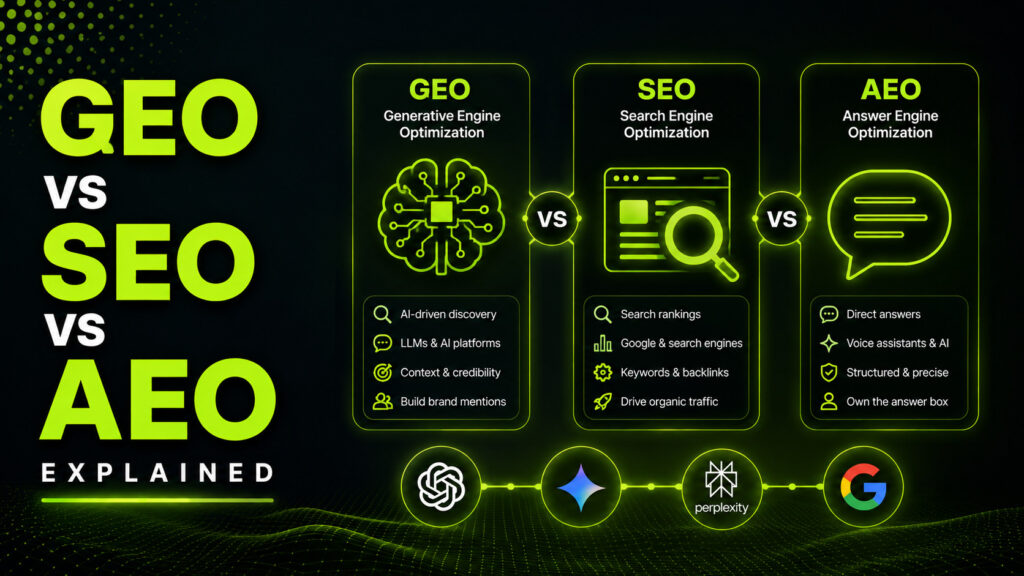
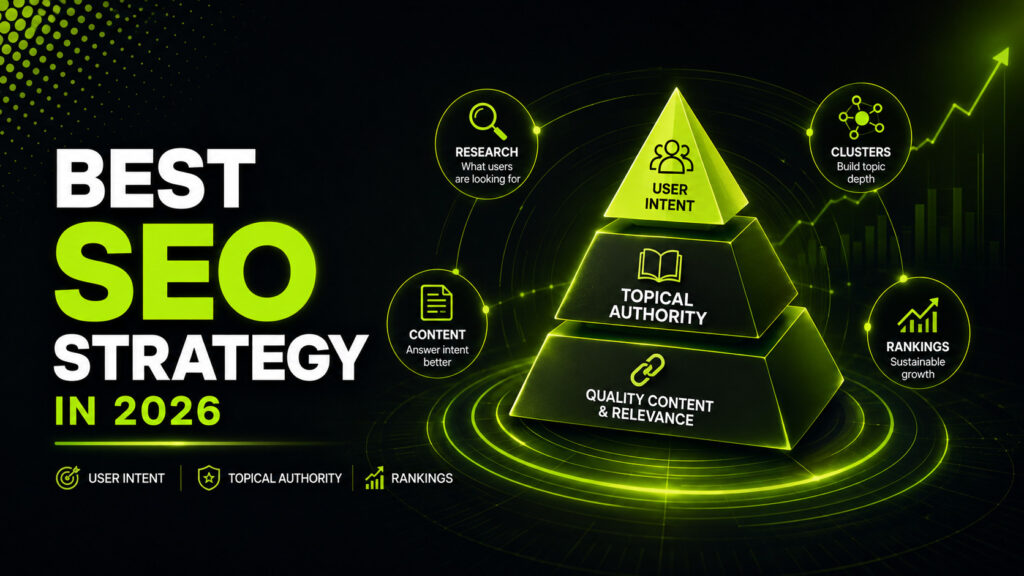
SEO, AEO, and GEO explained different problems, but they work best as a team. SEO ranks your pages in search engines. AEO increases your odds of becoming the direct answer to a question. GEO helps AI systems trust and reference your content when they write their own answers.
Whether you run a local shop, an online store, a SaaS company, or a blog, these three strategies together improve your visibility in search engines and in AI-driven search alike.
This guide covers:
- What SEO, AEO, and GEO mean
- How the three strategies differ
- When to use each one
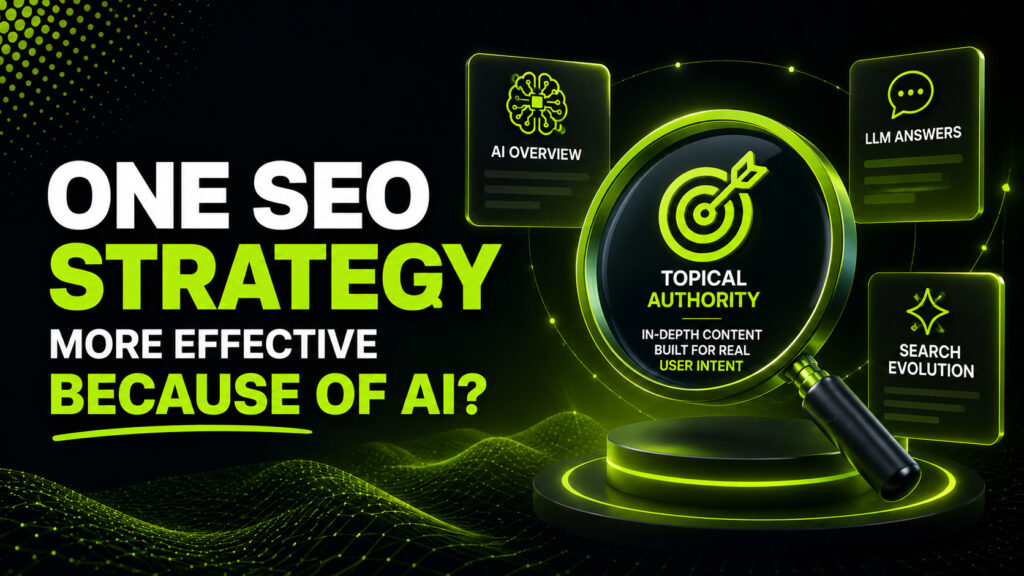
- How Google AI Overviews changed search
- Why AI platforms cite some sites and skip others
- What to prioritize in 2026
GEO vs SEO vs AEO Explained in One Minute
Short on time? Here’s the fast version.
SEO improves your website so search engines like Google and Bing can crawl, understand, and rank your pages.
AEO structures your content so answer engines can show it as a direct answer in Google AI Overviews, Featured Snippets, and voice assistants.
GEO helps AI systems such as ChatGPT, Gemini, Claude, and Perplexity understand and reference your content when they generate a response.
These three strategies don’t compete. Websites get the best results by combining all three.
| Strategy | Primary Goal | Main Platforms | Success Metric |
| SEO | Rank web pages | Google, Bing | Organic traffic and rankings |
| AEO | Become the direct answer | Google AI Overviews, Featured Snippets, Voice Search | Answer visibility |
| GEO | Increase AI citations | ChatGPT, Gemini, Perplexity, Claude | AI references and brand visibility |
Key takeaway: SEO builds visibility. AEO improves answer visibility. GEO strengthens AI discoverability.
How Search Changed From SEO to AI Search
For years, search followed one pattern. A user typed a keyword, scanned a list of links, opened a few pages, and pieced together an answer.
That pattern is fading. Many users now get a complete answer before they visit any website. Google AI Overviews pull from several sources at once. AI assistants answer complex, conversational questions directly.
This doesn’t make websites less important. It raises the bar. Your content needs to be easy for both people and machines to understand, check, and trust.
Search Evolution Timeline
| Year | Search Experience |
| Before 2015 | Keyword-focused search results |
| 2015–2020 | Mobile-first indexing, semantic search, structured data |
| 2021–2023 | E-E-A-T, helpful content, better understanding of search intent |
| 2024–2025 | AI Overviews, conversational search, growing use of large language models |
| 2026 | AI-assisted search, answer engines, AI citations, entity-based understanding |
AI hasn’t replaced traditional search. It has widened how people find information.
A few years ago, someone might have searched: “Difference between SEO and GEO.” They’d expect to read several articles to find the answer.
Today, that same person might ask: “Explain GEO vs SEO in simple words and tell me which one my business should focus on.”
Instead of ten blue links, they get one generated summary often with a citation to the source. That’s why content quality now matters more than ever.
Why AI Search Still Depends on Good Content
AI-powered search grew fast, but the basics of good content haven’t changed.
Google states that the principles behind helpful, people-first content still apply in AI-powered search. Original writing beats shortcuts or unproven optimization tricks. Google’s own documentation confirms there’s no secret “AI-only” ranking signal that overrides good SEO practice.
In short:
- Helpful content still wins.
- Technical SEO still matters.
- Trust still matters.
- Original information matters more than ever.
AI systems don’t just match keywords. They look at entities, the relationships between topics, structured information, and evidence that supports a claim.
What Is Search Engine Optimization (SEO)?
SEO is the practice of improving a website so search engines can find, understand, and rank its pages.
The goal is simple: help the right person find your content when they search for information, a product, or a service.
When someone searches “best SEO agency,” “local SEO services,” or “technical SEO checklist,” Google compares thousands of pages before it decides which ones rank higher. SEO helps your page become one of them.
How SEO Works
Search engines follow three main steps.
1. Crawling – Bots find pages by following links and sitemaps. A page that bots can’t crawl usually won’t appear in results.
2. Indexing – Once a search engine finds a page, it studies the content and stores it. Clear headings, descriptive titles, and internal links make this step easier.
3. Ranking – When someone searches, the engine compares indexed pages and ranks the most relevant, useful, and trustworthy ones. Ranking depends on many signals together: search intent, content quality, site speed, mobile usability, internal linking, topical authority, and brand credibility. No single factor decides the outcome.
Core Components of SEO
Technical SEO makes sure search engines can crawl and understand your site with minimal friction. Key elements: an XML sitemap, robots.txt, canonical URLs, HTTPS, strong Core Web Vitals, mobile-friendly design, fast page speed, and clean site architecture. The technical setup differs by platform — a WordPress SEO audit looks very different from a Shopify SEO or Wix SEO audit, so it helps to work from a checklist built for your specific platform.
On-page SEO improves individual pages: clear titles, logical headings, natural keyword use, internal links, descriptive alt text, and readable formatting. Modern SEO favors covering related concepts over repeating one keyword. An article on GEO vs SEO vs AEO, for example, should also touch on AI Overviews, search intent, structured data, the Knowledge Graph, entity SEO, and E-E-A-T. These related terms help search engines understand the page as a whole.
Off-page SEO builds your site’s reputation elsewhere: editorial backlinks, brand mentions, expert citations, and digital PR. A handful of trusted references beats hundreds of weak links.
Content SEO is the foundation. Pages that perform well tend to answer the question fully, include original examples, stay organized, get updated, and match what the searcher actually wants. Publishing one deep guide beats publishing ten thin articles.
Local SEO helps businesses that serve a specific area. A complete business profile, consistent business details, genuine reviews, and location-focused content all improve visibility in local search and map results. For service businesses, this often leads straight to qualified leads. Businesses without an in-house team often bring in an SEO agency to handle this work alongside the technical and content side.
Benefits of SEO
A strong SEO strategy can help a business:
- Grow qualified organic traffic
- Build visibility that lasts
- Spend less on paid ads
- Build brand credibility
- Attract high-intent visitors
- Support AEO and GEO efforts
SEO builds the foundation that AEO and GEO build on top of.
Limits of SEO
SEO alone won’t get you into AI-generated answers. A page can rank well in Google Search yet never appear in an AI Overview if it lacks a clear, structured answer or enough authority. Ranking for a keyword doesn’t guarantee an AI system will reference you when it answers a conversational question. That gap is where AEO and GEO come in.
What Is Answer Engine Optimization (AEO)?
AEO means structuring your content so answer engines can read it and present it as a direct answer.
Instead of pushing users to browse several pages, answer engines try to hand over the best answer right away. That’s why content needs clear questions, logical headings, and a format that both people and machines can follow easily.
Google AI Overviews, Featured Snippets, voice assistants, and AI search tools all rely on well-structured content to build their answers. Unlike SEO, where success means rankings and traffic, AEO succeeds when your content becomes the answer users see first.
How AEO Works
Answer engines check several signals before they pick a source:
- A clear question-and-answer format
- Accurate, complete explanations
- A logical heading structure
- Useful summaries
- Structured data, where it fits
- Strong topical authority
- Reliable sources
If someone asks, “What is the difference between SEO and AEO?” a typical SEO article might explain the answer over several paragraphs. An AEO-optimized article gives the short answer first, then backs it up with detail and examples. This helps readers and answer engines both.
Core Elements of AEO
Answer questions directly. Give the answer within the first few sentences. Don’t make readers dig for it.
What is AEO? Answer Engine Optimization is the practice of organizing content so AI-powered search tools and answer engines can display it as a direct answer.
Organize content clearly. Each section should follow a simple pattern: a clear heading, a short answer, a supporting explanation, and a practical example.
Match natural language. People don’t just type “SEO vs GEO” anymore. They ask, “Which is better for my business, SEO or GEO?” Write content the way people actually talk. This also helps voice search.
Build topical depth. Answer one question, then cover the related ones nearby: AI Overviews, search intent, structured data, entity optimization, and topical authority. This completeness helps both readers and machines.
Benefits of AEO
AEO can help a business:
- Show up more often in AI-generated answers
- Win more Featured Snippets
- Perform better in voice search
- Build brand awareness
- Improve clarity and user experience
Many users now get an answer without opening a single website. Appearing in that answer keeps your brand visible during that moment.
Limits of AEO
Good formatting alone doesn’t build lasting authority. Content still needs real expertise, originality, and trustworthy information behind it. A page with great structure but weak substance rarely becomes a reliable source.
AEO in Practice
Imagine a bakery owner searches: “How long does Local SEO take?”
A weak opening: “Local SEO is an important strategy that many businesses use because it helps improve online visibility across different search engines…”
A strong AEO opening: “Most local businesses start seeing measurable improvements from Local SEO within three to six months, though results depend on competition, site quality, and consistency.”
The detail follows after. The answer comes first, because that’s what the reader and the answer engine wants.
What Is Generative Engine Optimization (GEO)?
GEO means making your content easy for AI systems to understand, trust, and reference when they generate a response.
Where SEO ranks pages, GEO raises the odds that an AI platform actually uses your content in its answer. Generative AI doesn’t just match keywords it weighs topics, entities, relationships, authority, and evidence before it writes a response.
How GEO Works
Generative AI systems ask a different set of questions about your content:
- What does this page actually cover?
- Is the information accurate?
- How do the topics connect?
- Does this show real expertise?
- Do other trusted sources say something similar?
- Does this add something new?
Pages that answer these questions well stand a better chance of getting cited.
Core Elements of GEO
Entity optimization. AI understands entities, not isolated keywords. A page about SEO naturally connects to Google Search Console, Google Analytics, Core Web Vitals, structured data, the Knowledge Graph, and topical authority. Linking these ideas helps AI grasp the full picture.
Original information. Originality separates average content from content worth citing. Add practical examples, real workflows, comparison frameworks, original visuals, and first-hand observations. Unique material gives an AI system a reason to reference you instead of a competitor.
Strong brand signals. AI systems weigh credibility, too. Clear author information, editorial standards, contact details, consistent publishing, and reliable citations all build confidence in your content.
Clear relationships between topics. Build connected clusters instead of isolated pages — for example, SEO → Technical SEO → On-Page SEO → Local SEO → Entity SEO → Structured Data → AI Overviews. This structure shows both readers and AI systems that you understand the subject in full.
Benefits of GEO
GEO can help a business:
- Gain visibility across AI-powered search
- Strengthen brand recognition
- Build topical authority
- Prepare for future AI search changes
- Support existing SEO and AEO work
GEO doesn’t replace SEO. It extends your reach into AI-generated conversations.
Limits of GEO
No strategy can guarantee an AI citation. Each AI platform retrieves and generates information differently. The most reliable path is to publish accurate, original, well-structured content that shows genuine expertise. Google advises focusing on helpful content rather than chasing undocumented AI ranking signals.
SEO vs AEO vs GEO: Comparison
| Feature | SEO | AEO | GEO |
| Primary Goal | Rank web pages | Become the direct answer | Increase AI visibility and citations |
| Primary Audience | Search engine users | Users seeking quick answers | Users interacting with AI assistants |
| Main Platforms | Google, Bing | Google AI Overviews, Featured Snippets, Voice Search | ChatGPT, Gemini, Claude, Perplexity |
| Focus | Search rankings | Answer visibility | AI understanding |
| Optimization Method | Keywords, technical SEO, content quality | Question-based content, concise answers, structured formatting | Entities, topical authority, original information, trust |
| Success Metric | Organic traffic | Featured answers and AI summaries | AI references, citations, brand visibility |
| Content Style | Comprehensive | Direct and structured | Comprehensive, contextual, evidence-based |
Key Differences
- SEO helps search engines find and rank your pages.
- AEO helps answer engines pick the best response to a question.
- GEO helps generative AI understand your expertise and cite your content.
Picture them as three layers, not three competitors: SEO gets people to your site, AEO gets them a fast answer, and GEO gets AI systems to trust and use what you wrote.
What They Have in Common
All three reward the same things:
- Helpful content
- A strong user experience
- Accurate information
- Clear structure
- Topical authority
- Reliable sources
- Fast, accessible websites
- Content that matches what the reader actually wants
Whether someone finds you through Google Search or an AI assistant, quality is still the foundation.
How to Optimize for All Three Together
Most businesses treat SEO, AEO, and GEO as separate projects. They work better as one.
Step 1: Start With Search Intent
Ask what problem the reader is trying to solve, what they’ll ask next, and what would help them decide. For this topic, readers want more than definitions they want to know which strategy to prioritize and how to act on it. Answer both the main question and the follow-ups.
Step 2: Build Comprehensive Content
Cover a topic from every practical angle in one place definitions, benefits, limits, differences, examples, best practices, and mistakes to avoid instead of splitting it into several thin articles. This builds topical authority and covers more search intent at once.
Step 3: Organize Information Logically
Use clear headings, short paragraphs, numbered steps, bullet lists, and comparison tables. Each heading should answer one specific question, such as “What Is GEO?” or “How Can You Optimize for GEO?” This helps readers and AI systems find what they need fast.
Step 4: Write for People First
Explain concepts plainly. Use real examples. Answer questions honestly. Back up claims with reliable sources. Cut filler. Content written for people tends to perform better over time than content written for algorithms.
Step 5: Show Real Experience
Don’t just state a rule explain why it works. Instead of “Internal linking is important,” try: “A well-planned internal linking structure helps search engines find related pages while guiding readers to more resources. A pillar page about SEO, for instance, can link out to guides on technical SEO, keyword research, and structured data.” Specific detail builds trust.
Step 6: Build Topical Authority
One strong article helps. A full library on the same subject helps more. This guide, for example, could connect to separate pieces on technical SEO, local SEO, entity SEO, schema markup, and platform-specific guides like WordPress SEO, Shopify SEO, Squarespace SEO, Wix SEO, and WooCommerce SEO. Those connections establish your site as a real authority.
Step 7: Use Natural Entity Relationships
Introduce related terms where they add value instead of repeating your main keyword Google Search, AI Overviews, Bing, ChatGPT, Gemini, Claude, Perplexity, structured data, semantic search, E-E-A-T. These connections build a fuller picture of the topic for both readers and machines.
How Google AI Overviews Changed Search
Google AI Overviews mark one of the biggest shifts in search in years. Instead of a list of pages, Google can generate a summarized answer pulled from multiple trusted sources.
Someone searching “How do SEO, AEO, and GEO differ?” might get a full summary before they open a single website. That means sites now compete for two things: a ranking position and a spot inside the AI-generated summary.
Google has been direct about one point: keep building helpful, original, people-first content. Don’t chase undocumented AI tricks. Strong SEO fundamentals still carry the most weight.
How ChatGPT, Gemini, and Perplexity Evaluate Content
Each AI platform works differently under the hood, but they share similar priorities. They favor content that is accurate, well organized, complete in context, easy to follow, backed by trustworthy sources, and published by a credible source.
Consistency matters too. When multiple trusted sources agree on the same facts, an AI system’s confidence in that information goes up. Accuracy and reliable references remain some of the strongest signals you can offer.
Why Brand Authority Matters More Than Ever
Ranking for a keyword is useful. Being recognized as a trusted source is more valuable. AI systems increasingly judge brands as a whole, not just individual pages.
Strong brands tend to show consistent publishing, accurate information, real subject expertise, reliable citations, a good reputation, and clear, transparent ownership. Authority builds gradually through consistent quality not through quick tricks.
Common Mistakes to Avoid
Publishing thin content. A brief overview that adds nothing new rarely becomes a source anyone trusts. Aim for depth.
Chasing keywords instead of intent. Answer the actual question a reader has, instead of repeating a phrase.
Ignoring content updates. Search changes fast. Revisit key articles and refresh statistics, examples, and references regularly.
Overlooking technical SEO. Great writing can’t perform well on a site that’s slow, hard to navigate, or difficult to crawl.
Forgetting internal links. Every important article should connect naturally to related resources on your site.
Publishing without evidence. Support important claims with real, checkable references. That’s what builds trust with readers and with the systems evaluating your content.
Where to Get Help Executing This
Reading about SEO, AEO, and GEO is one thing. Executing on a live site is another, and the right approach depends on your platform. If you’re on WordPress, that means a WordPress SEO setup. On Shopify, it’s Shopify SEO and product-page structure. On Wix, Squarespace, or a GoDaddy-built site, the technical constraints differ again see Wix SEO, Squarespace SEO, or GoDaddy Website Builder SEO for platform-specific guidance. Running an online store on WooCommerce has its own checklist too, covered in this WooCommerce SEO guide.
If you’d rather hand this off, Rankny works across all of these platforms and can audit and manage the SEO, AEO, and GEO work end to end.
Frequently Asked Questions
Is GEO replacing SEO? No. SEO remains the foundation for search visibility. GEO builds on it by helping AI systems better understand and reference high-quality content.
Is AEO different from SEO? Yes. SEO improves rankings in search results. AEO shapes content for direct answers in AI-powered search, featured snippets, and voice assistants.
Which strategy should businesses prioritize? Start with strong SEO fundamentals. Once those are solid, add AEO and GEO techniques to expand your reach across AI-powered platforms.
Does structured data improve AI visibility? Structured data helps search engines read your content accurately. It doesn’t guarantee an AI citation, but it improves how well your content gets interpreted and can help you qualify for certain search features.
Can small businesses benefit from GEO? Yes. A small business that publishes helpful, trustworthy, well-structured content can gain visibility in both traditional search and AI-generated answers no massive budget required.