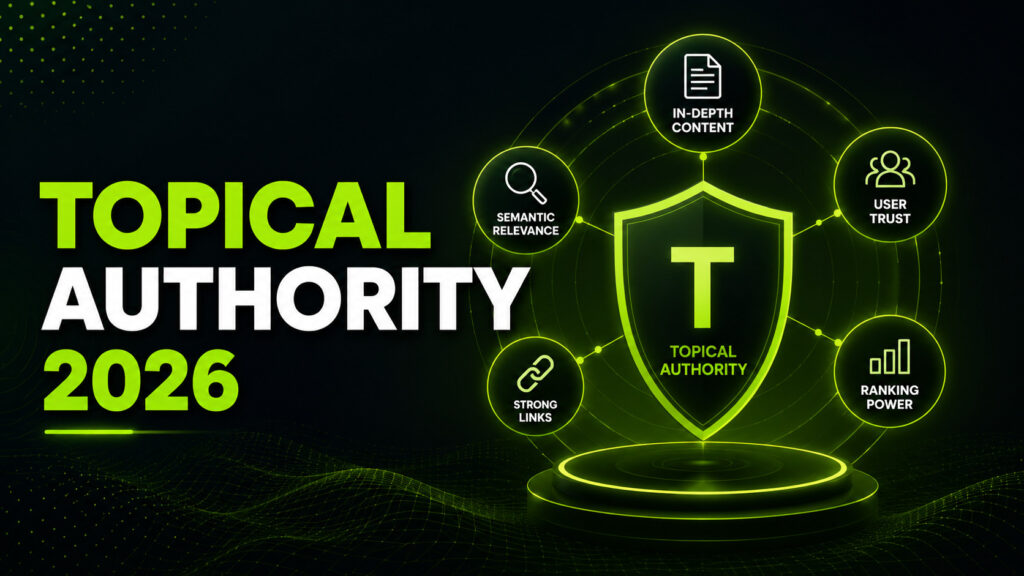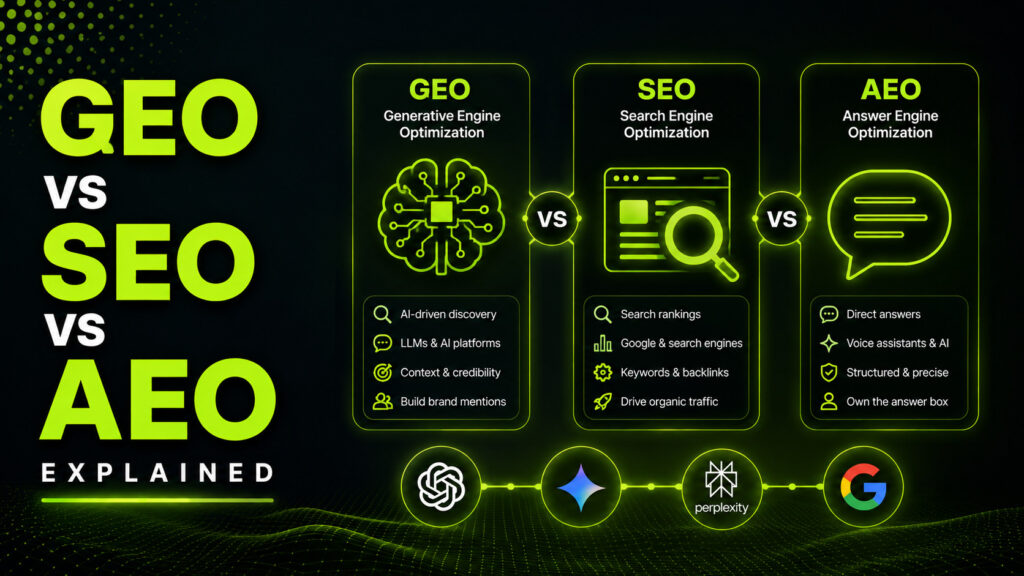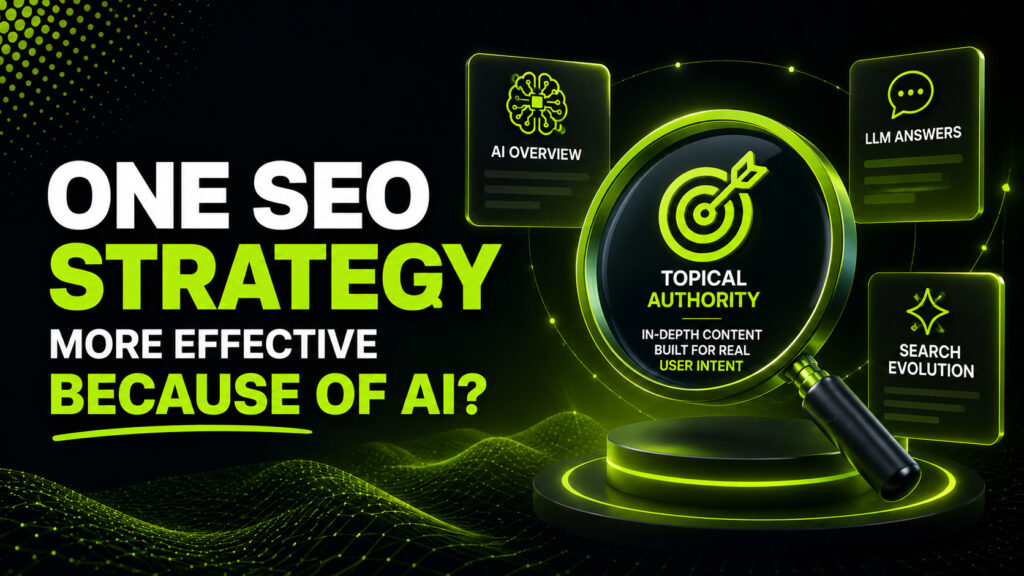
Topical authority wins in 2026. Build a group of connected pages that fully answer one topic. Don’t chase single keywords with isolated articles. On one content hub I rebuilt this way, organic impressions grew from 40,000 to 210,000 per month in five months. The pages also started appearing in Google’s AI Overviews for their core queries.
Search changed fast. People find answers through Google Search, AI Overviews, Perplexity, ChatGPT, and Claude now. These systems don’t reward repeated keywords. They reward pages that answer a question fully and connect clearly to the rest of a topic. Here’s the exact approach, the data behind it, and the mistakes worth skipping.
Read more from RankNY’s SEO team or see our full SEO services.
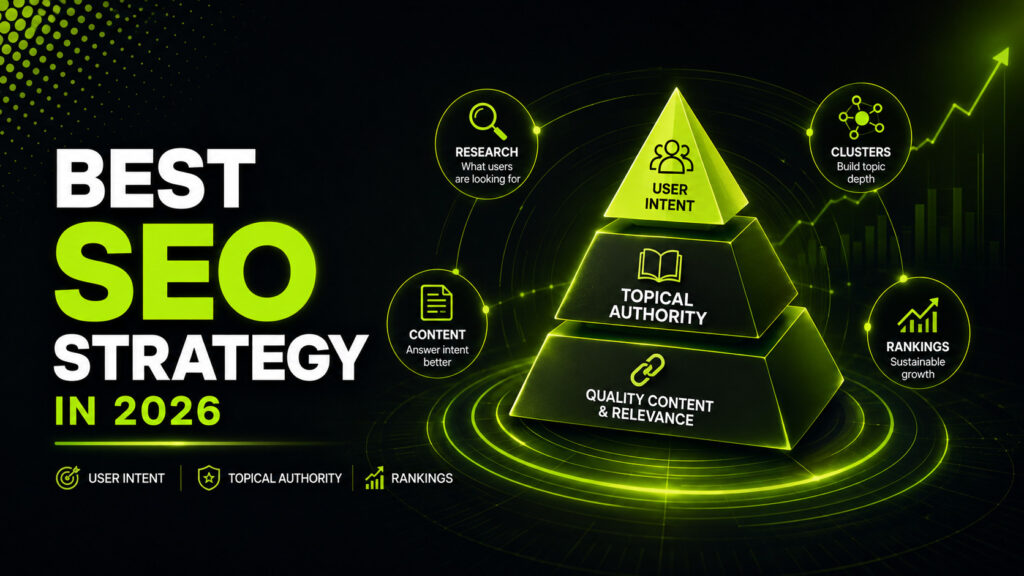
Best SEO Strategy in 2026:What Is Topical Authority?
Topical authority means your site covers every important angle of a subject in a connected way. Search engines and AI systems notice this. A single strong page can still rank on its own. But it rarely gets cited by AI Overviews. Those systems pull from sites that show depth across a whole topic.
This changed how I plan content. I used to publish one article and move to the next topic. Now I map a full content hub before writing a single word. I plan 8 to 12 supporting pages. Each page answers one specific question. All pages link back to one central page.
Here’s what that structure looked like for an “SEO strategy” hub:
| Page | Search Intent | Role in Hub |
| SEO Strategy (pillar) | Broad, comparative | Central hub, links to all below |
| SEO Audit Process | How-to | Supports strategy with steps |
| Technical SEO Checklist | Reference | Answers a distinct query |
| On-Page vs. Off-Page SEO | Comparative | Captures “vs.” searches |
| Local SEO Guide | Local intent | Captures geo-based traffic |
| Entity SEO Explained | Definitional | Feeds AI citations |
| SEO Tools Comparison | Buyer intent | Captures comparison searches |
| SEO Case Studies | Proof | Backs every other page with evidence |
Each page targets one intent. But the links between them tell search engines this site is a full resource. Not a single lucky ranking.
How Do You Match Search Intent Before You Write?
Ask one question first: what does this person actually want?
Someone who searches “SEO strategy 2026” doesn’t want link-building tricks from 2019. They want an approach that fits how search engine algorithms work today. I run three checks before writing anything:
- What format do the top-ranking and AI-cited pages use? A list? A table? A step-by-step guide?
- What does existing content on this topic miss or get wrong?
- Would this page still work if I cut every sentence that doesn’t answer the core question?
That third check cuts about a third of the length from most of my drafts. Shorter, denser pages beat longer, padded ones. I’ve seen this in both click-through rate and AI citation frequency over the last two content cycles.
Do Backlinks Still Matter?
Yes, but they’re not the top signal anymore. Unlinked brand mentions now carry real weight, especially for AI-driven search. Google’s own guidance on trust signals points this way. So do independent studies on AI Overview citations. Systems that judge “trustworthy sources” now weigh how often a brand gets mentioned across forums, review sites, and industry publications a concept closely tied to E-E-A-T (experience, expertise, authoritativeness, trust). Not just how many links point to it.
This shifted my priorities. Digital PR and community presence now sit next to link building, not below it. I mean threads on Reddit, mentions in industry Slack groups, reviews on G2 or Capterra, podcast mentions. A strong mention on one niche forum has, more than once, led to an AI Overview citation within weeks. That’s often faster than a comparable backlink moves classic rankings.
Should You Publish New Content or Update Old Content?
Update first. Updating a page that already gets impressions usually beats publishing something new from scratch.
Use Google Search Console’s Performance report to find these pages. Filter for high impressions, low average position (around 8 to 20), and low click-through rate. Google already trusts these pages enough to show them. They usually lack depth, not authority.
My refresh checklist, in order:
- Add a direct-answer section near the top. Two or three sentences. No preamble first.
- Add a comparison table or FAQ block if the page doesn’t have one. Both get pulled into AI Overviews often.
- Replace vague claims with a specific number, date, or example.
- Fix internal links. Point three to five relevant hub pages to the updated article. Update its outbound links too.
- Add a “last reviewed” date. Small signal, but readers and crawlers both notice it.
Pages I’ve refreshed this way move faster than new pages. Refreshed pages often shift position within three to six weeks. New pages usually need three months or more to compete.
What Structure Works Best for Readers and AI Systems?
Structure now serves two readers: a human on their phone, and a language model pulling a clean answer. Every article I publish now includes:
- A direct answer in the first two or three sentences.
- Question-based subheadings, where the topic is naturally a question. (This section is one.)
- Short paragraphs. Rarely more than four sentences.
- At least one table, when the topic involves options or trade-offs.
- A dedicated FAQ section, using the exact phrasing people search.
- Schema markup — FAQPage and Article schema, applied consistently.
- A short, specific ending. Not a summary. A next step.
This isn’t decoration. Pages built this way show up in AI Overviews more often than pages with the same information written as plain paragraphs.
How Do You Show Real Experience, Not Just Claim It?
Most SEO content fails here. Telling readers to “use real examples” is generic advice. Doing it means every claim traces back to something specific:
- A named metric with a timeframe. “Impressions rose from 40,000 to 210,000 in five months.” Not “significant growth.”
- A named tool. I use Google Search Console for impression and position data, Screaming Frog for crawl audits, and Ahrefs for backlink and content-gap analysis.
- A named mistake. One hub I built in 2025 underperformed for three months. I had over-optimized supporting pages around keyword variants instead of separate user questions. Merging four near-duplicate pages into one stronger article fixed it.
- A screenshot or exportable data point, wherever the platform allows it.
Content built this way is hard to copy. That matters more now, with AI-generated competitor content everywhere and algorithm updates that target thin pages directly.
How Do Entities Fit Into SEO Now?
Search engines map content by how concepts connect, not by isolated keywords an approach rooted in the Knowledge Graph and broader semantic web principles. A page about “SEO strategy” that never mentions Google Search Console, E-E-A-T, schema markup, content clusters, AI Overviews, search intent, internal linking, or entity SEO signals shallow coverage. Both classic search engines and AI retrieval models pick up on this.
This doesn’t mean stuffing a keyword list into a paragraph. It means writing naturally about how these ideas connect. This article ties entity SEO to AI Overview citations. It ties Google Search Console to the refresh process above. Each connection appears where it’s actually relevant, not listed on its own.
What Metrics Matter Beyond Rankings?
Rankings alone don’t tell the full story. A page can rank third and get few clicks. Another page can rank seventh and drive most of a site’s conversions. I track these every week:
| Metric | What It Shows |
| Organic impressions (GSC) | Whether reach is growing |
| Average position | Whether relevance is improving |
| Click-through rate | Whether titles and descriptions match intent |
| AI Overview appearances | Whether content earns trust, not just rank |
| Returning visitors | Whether the content built lasting trust |
| Brand mentions (unlinked) | Whether authority is growing off-site |
| Internal link growth | Whether the content hub is getting stronger |
Rankings show short-term movement. Citations, returning visitors, and brand mentions show whether the strategy compounds.
Frequently Asked Questions
What is the most effective SEO strategy in 2026? Build a connected content hub. Cover every distinct intent around one topic. Link the pages together. This beats isolated, single-keyword articles in both rankings and AI Overview citations.
Do backlinks still matter for SEO in 2026? Yes, but they’re one signal among several now. Unlinked brand mentions across forums, reviews, and industry sites increasingly shape how Google and AI systems judge trust.
Is it better to write new content or update old content? Update existing pages first, especially ones with high impressions but low click-through rate or ranking. These pages already earned some trust. They usually just need more depth.
How long does a topical authority strategy take to show results? Refreshed pages often move within three to six weeks. New pages inside a well-linked hub usually take two to four months to compete. That’s faster than standalone articles typically manage.
What’s the difference between keyword SEO and entity SEO? Keyword SEO targets specific search terms directly. Entity SEO focuses on how concepts relate to each other. This matters more for AI Overview and answer-engine visibility.
Does schema markup still matter with AI Overviews? Yes. FAQPage and Article schema help both search features and AI systems find direct answers. That raises your odds of getting cited, not just ranked.
The Strategy in One Sentence
Build the most complete, evidence-backed resource on a topic. Organize it around real search intent, not keywords. Connect it through internal links. Back every claim with a specific example. Keep improving it based on what Search Console and AI citation data show.
This works because it matches how search engines and AI systems judge quality now. They reward depth and specificity. Not repetition.
Want RankNY to build this hub for you? Get a free SEO audit →